

Research Projects
We develop additive manufacturing methods to fabricate electronics in new ways and deploy them in new places. Our work is built on three fabrication technologies: printed electronics, laser-induced graphene (LIG) and the integration of electronics with 3D printing. We use these to make two main classes of devices: sensors and transistors, in particular organic electrochemical transistors (OECTs). Our target applications include environmental air pollution monitoring, plant nutrient and water quality sensing, and wearable health monitoring.
Technologies
Printed electronics
Inkjet and dispense printing deposit conductors, semiconductors and dielectrics digitally, without masks or etching. Printed features rarely come out exactly as designed: ink spreads, dries non-uniformly and forms coffee rings, which changes the geometry and electrical performance of devices. We study and control these ink-surface interactions, for example by optimizing the order of droplet placement, printing on hydrophobic surfaces using sequential drying, and understanding how pattern geometry affects the resistivity of printed conductors. We also use machine learning and machine vision to predict how new inks will jet and to generate optimized print sequences, reducing the trial and error needed to bring a new material into the printer.

Inkjet-printed transistors with carbon nanotubes aligned by the coffee ring effect. From P. Naderi and G. Grau, Flexible and Printed Electronics, 2024.
Laser-induced graphene (LIG)
LIG is formed in a single step by scanning a laser over a polymer, converting its surface into conductive, porous graphene. No inks, masks or clean room are required, and patterns can be changed instantly in software. We work on controlling the process, for example by maximizing conductivity through laser energy delivery and pulse overlap and by using machine learning to predict the properties of LIG from laser parameters and polymer precursors. We also make LIG more robust through encapsulation. We functionalize LIG, for example by plasma treatment, printed ion-selective layers or metal oxides formed in situ during the laser process, so that it responds selectively to specific chemical species. LIG serves as both electrode and sensing element in many of our devices.

Controlling laser pulse overlap to produce low-resistance laser-induced graphitic carbon. From A. Minhas-Khan, S. Nambi and G. Grau, Carbon, 2021.
Integration of electronics with 3D printing
Combining 3D printing with printed electronics allows sensors and circuits to be built directly into customized 3D parts. We engineer 3D printed surfaces for high-quality printed electronics, for example by planarizing them through ironing, and we convert 3D printed engineering plastics directly into conductive LIG traces. We also combine 3D printed microfluidic channels with LIG electrodes to create complete, low-cost electrochemical sensing systems in a single additive manufacturing workflow.

Laser-induced graphene conductors written directly onto 3D printed structures. From M. Tavakkoli Gilavan et al., ACS Applied Electronic Materials, 2021.
Devices
Sensors
We develop low-cost chemical, electrochemical and physical sensors. Examples include microfluidic LIG electrochemical sensors for ions such as lithium, sensors for airborne black carbon particulates, wearable temperature sensors, and printed strain and damage sensors on carbon fiber composites for structural health monitoring.
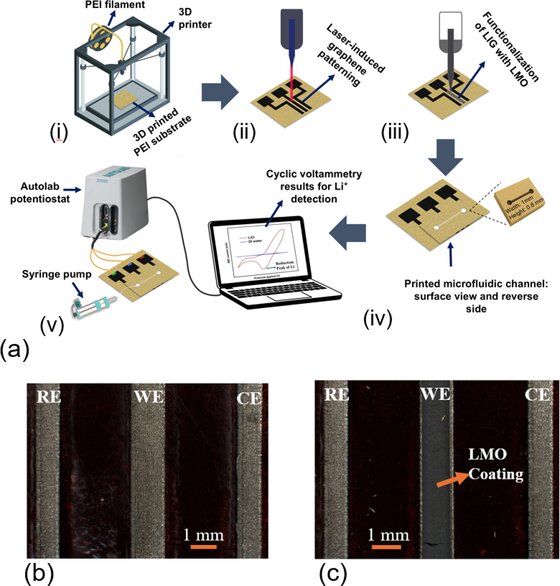
Single additive manufacturing workflow for an electrochemical sensor: LIG electrodes on a 3D printed substrate, printed functionalization and a 3D printed microfluidic channel. From S. D. Shovan et al., ACS Applied Materials & Interfaces, 2026.
Organic electrochemical transistors (OECTs) and printed transistors
Transistors amplify small signals, which makes them powerful building blocks for sensitive sensors. OECTs operate at low voltages in direct contact with liquids, so they are particularly well suited to chemical and biological sensing. We have demonstrated OECTs with LIG electrodes and fully printed OECTs with low-resistance electrodes on planarized 3D printed substrates, and we are now developing fully printed OECTs with high transconductance for electrochemical sensing. We also print thin-film transistors using organic semiconductors and aligned carbon nanotubes, and study hydrophobic gate dielectrics for printed transistors.

Fully printed OECTs on a planarized 3D printed substrate. From M. K. Idris et al., Advanced Materials Technologies, 2026.
Applications
Environmental air pollution
Black carbon, a pollutant released by vehicle exhaust and wildfire smoke, harms human health and contributes to climate change, yet it is difficult to measure with low-cost instruments. We are developing low-cost, low-waste sensors to detect black carbon particulates. This work is part of an interdisciplinary project, which brings together engineers, atmospheric scientists, artists and designers at York University to integrate the sensors into wearable artworks that make invisible air pollution visible to the public.
Plant nutrients and water quality
Knowing nutrient levels precisely helps growers use fertilizer efficiently and reduces runoff. We are developing low-cost, portable sensors based on LIG and printed OECTs to monitor nutrients and water quality in hydroponic systems. Our ion-selective LIG sensors also address the detection of water contaminants and of ions such as lithium, whose monitoring is becoming increasingly important with the growth of clean energy technologies. We are moving this technology toward commercialization through a start-up company.
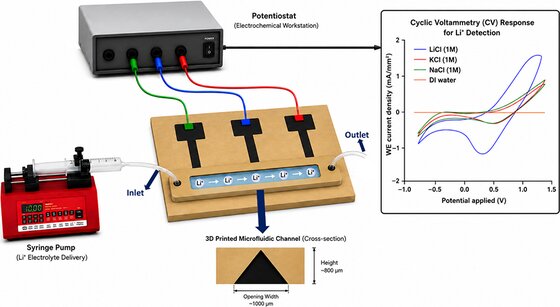
Microfluidic sensor for lithium ions in water, combining functionalized LIG electrodes with a 3D printed channel. From S. D. Shovan et al., ACS Applied Materials & Interfaces, 2026.
Wearable health monitoring
Flexible, printed sensors can be integrated into textiles and wearable devices for comfortable, continuous monitoring. Together with our industry partner Fibra, we are developing smart textiles with integrated sensing and AI-driven analysis for women's reproductive health. We also contribute printed electrodes and sensors to collaborative projects on wearable EEG for epilepsy management and an instrumented smart knee brace.